Polygon - Multi-Layer Gap
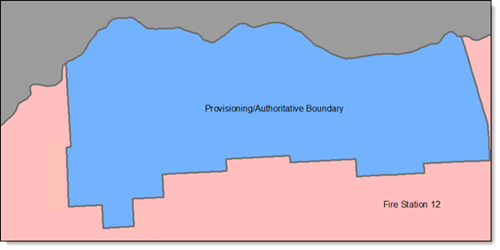
The Polygon - Multi-Layer Gap quality control (QC Quality Control) check identifies where gaps exist in a polygon layer when compared to another authoritative polygon layer. For example, using a Provisioning Boundary as the authoritative polygon layer and comparing your Fire Boundary against it. Any gaps in your Fire Boundary as compared to the Provisioning Boundary will flag to ensure your Fire Boundary fully covers your Provisioning Boundary once all fallouts are fixed.
Note: By default, this QC check accounts for snapping tolerance. Polygon features with over 1 million vertices will be simplified to ensure performance. Projection-Based Unit is used in this check. Projection-Based Unit indicates the unit of measurement is pulled from the Spatial QC Projection this data target uses. If no Spatial QC Projection is used in this data target, the unit is pulled from the Data Target's projection.
Note: By default, Polygon - Multi-Layer Gap accounts for snapping tolerance within GIS Geographic Information System. A computer application that involves storing and manipulating electronic maps and related data. Also, mapping software combining spatial information about where places and events are located with data attributes describing those places and events. editing applications. The following are applied automatically when the Sliver Filter parameter is configured.
- Feet: When configured to 0, the check runs with built-in tolerance of 0.0087 feet for all spatial reference systems measured in feet like most state plane projections.
- Meters: When configured to 0, the check runs with built-in tolerance of 0.0027 meters for all spatial reference systems measured in meters.
 Required QC Prerequisites
To run this check, two polygon feature classes are required.
Configure QC Parameters
Configurations for QC check parameters contain filters to prevent selecting incompatible field types.
The following parameters can be specifically configured for the Polygon - Multi-Layer Gap QC check.
- Run On: Non-configurable. This QC check inspects the target dataset.
-
Severity: Sets the importance level of this QC check’s fallouts. Critical fallouts prevent export package outputs but will still provide fallouts.
-
Polygon Layer to Validate: The polygon layer that will be analyzed for gaps compared to the baseline layer. For example: Fire_Boundary or EMS Emergency Medical Service. Response centers for services such as ambulance, fire department, hospital, and poisen control center._Boundary.
-
Reporting Unique ID: A unique identifier in the validation polygon that can be used to uniquely identify a singular feature.
-
Baseline Polygon Layer Name: The authoritative polygon layer used as the standard for comparison. Serves as the control layer against which gaps are detected. For example: Provisioning_Boundary or PSAP Public Safety Answering Point. A set of call takers authorized by a governing body and operating under common management which receives 9-1-1 calls and asynchronous event notifications for a defined geographic area and processes those calls and events according to a specified operational policy._Boundary.
-
Smallest Gap to Report (Projection-Based Unit): Use to ignore gaps smaller than a specified square area. 0 is recommended and enforces the highest level of accuracy.
-
Sliver Filter (Projection-Based Unit): Shrinks gap dimensions from all sides by this set distance to remove slivers from the results. 0 is strongly recommended and enforces the highest level of accuracy. For example, a 0.5 ft filter would shrink a 50 ft × 1 ft gap to 49 ft × 0 ft, excluding it from the fallouts.
What does the Polygon - Multi-Layer Gap QC Check Output Include?
The following information is included for this QC check's fallout output.
- QC check name
- Description of the QC check
- Feature class where the fallout appears
- Extended information providing more details about the fallout
- Latitude and Longitude of the fallout's location
Examples - Fallout Report Records
The example below shows possible error messages you may receive when a record fails the Polygon - Multi-Layer Gap check. The extended information provides the base layer name, the layer it was compared to, and the size of the gap detected in either square meters or feet. The unique feature ID displays the ID’s of the polygons surrounding the gap, helping to pinpoint the gap referenced by the fallout

Examples - Issues Reported
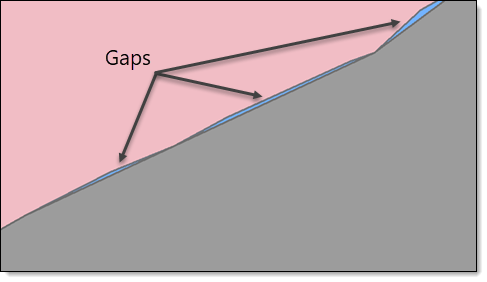
Gaps are most often found in sliver polygons along an edge. In this example, the Provisioning Boundary is in blue and the Fire Boundary is pink. The two boundaries are not perfectly aligned, resulting in some areas where the Fire Boundary does not cover the Provisioning Boundary. Anywhere where you see the blue Provisioning Boundary would be reported as a gap.
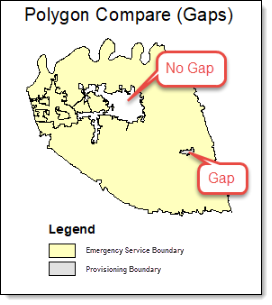
In this example, the sections marked as Gaps are gaps because the Emergency Service Boundary does not cover the Authoritative Boundary. The space labeled No Gap is not a gap because the Authoritative Boundary does not cover that space.
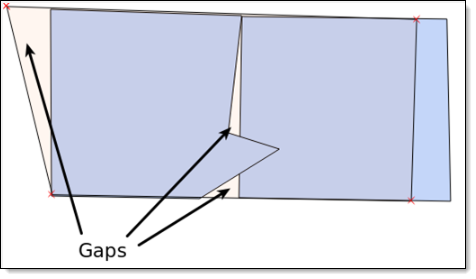
In this example, the area in blue would be reported as a gap because there is no coverage by the Fire Boundary in an area where the Authoritative Boundary exists.